Preview image
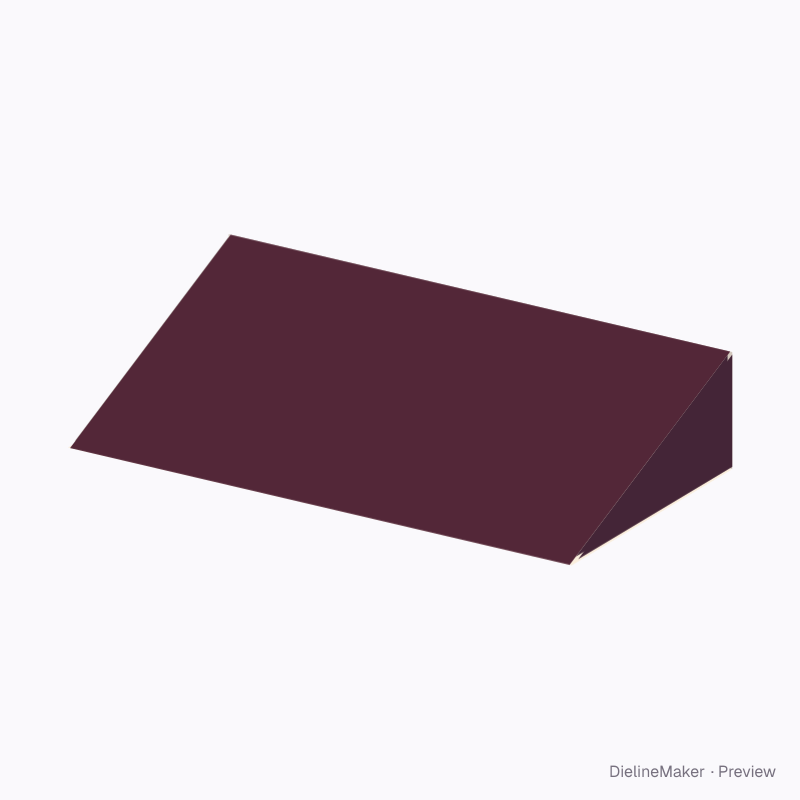
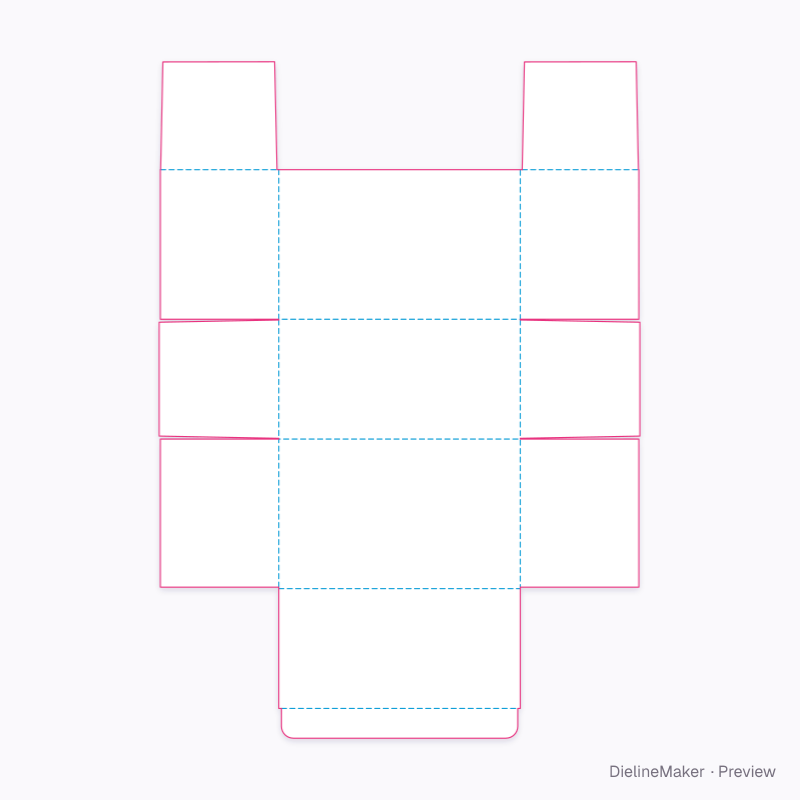
The real blank at this size, folded by the same engine as the studio. The artwork is a sample from a fictional brand — swap in your own in the editor.
DM-WEDGE-TUCK-01Tuck end
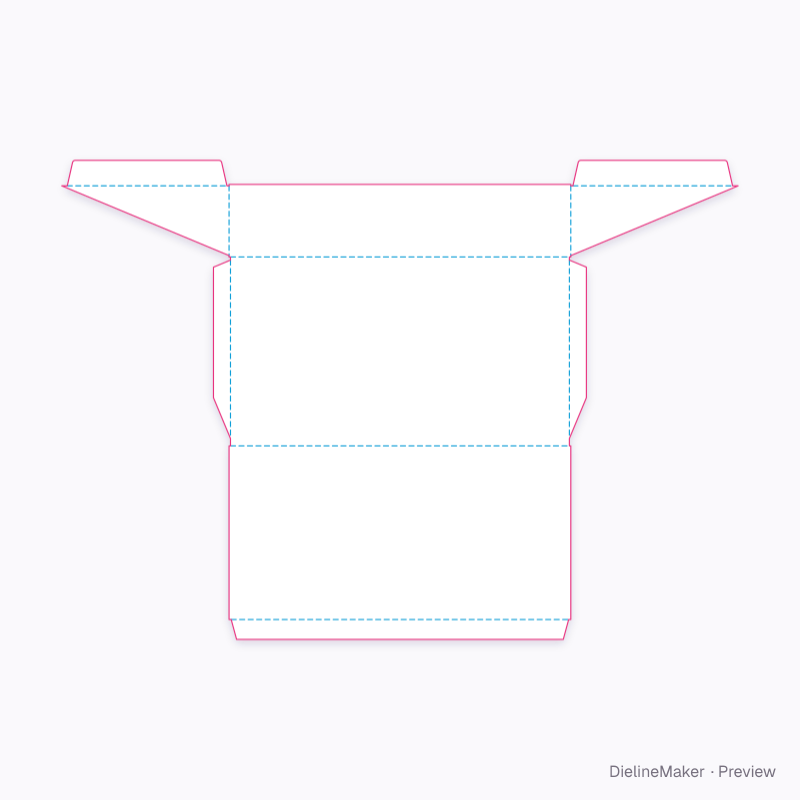
Wide praline chocolate wedge dieline
A wide carton with a rectangular base, vertical back and sloping top. Both triangular end doors hinge from the back, tuck along the inside floor and close over dust flaps. One glued rear seam forms the body. Dimensions describe the clear body before closure plies; prove fit and scoring with the chosen board. A ready-sized preset of the straight-tuck wedge carton — change the length, width and height and every panel, tuck and glue flap is redrawn to match.
Inside240 × 120 × 50 mm
Outside241 × 123.2 × 51.7 mm
Flat blank477 × 338 mm
Download the dielinePro
Sign in to download. Dieline downloads are part of Pro: PDF, Illustrator, SVG and DXF, cut, crease and bleed on separate layers, without a watermark. See plans
- Reference
- DM-WEDGE-TUCK-01
- Structure
- Straight-tuck wedge carton
- Inside size
- Inside span 240 · Inside base depth 120 · Inside rear height 50 mm
- Size range
- Inside span 80–400 · Inside base depth 40–240 · Inside rear height 25–150 mm
- Manufacturing
- 241 × 122.5 × 51.3 mm score to score · inside vs outside sizes
- Parts
- One blank
- Board area
- 0.089 m² · about 4 up on a 720 × 1020 mm sheet
- Default board
- Black-core board 350 g · 0.5 mm caliper
- Board options
- SBS 350FBB 400Kraft 350Black 350SBS 18 pt
- Good for
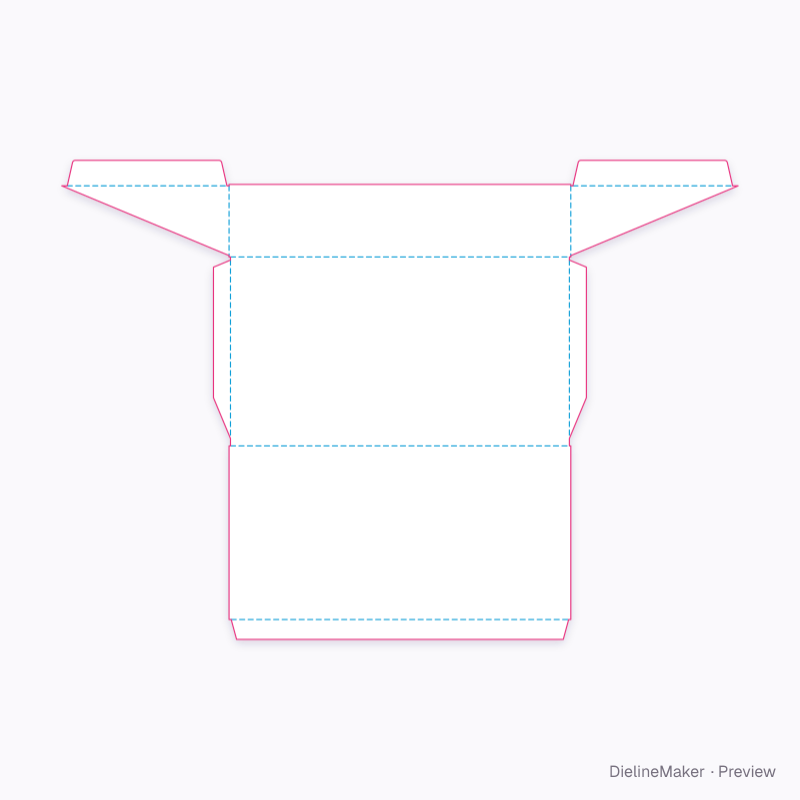
The flat dieline
Exactly what the downloads contain, drawn from the template at its default size, with a 3 mm bleed. How to read a dieline.
- Crease
- Cut
- Glue area
- Bleed 3 mm
How it folds
The wide praline chocolate wedge erects in 4 steps, in the order the creases are scored to take. The editor plays the same sequence in 3D and lights each step’s creases on the dieline.
- 1Fold the walls upSloping top
- 2Fold the glue flap and glue the seamGlue flap, Vertical back
- 3Fold the dust flaps inEnd dust flap, Straight end tuck and 2 more
- 4Close the lidLeft triangular end, Right triangular end
How the blank is sized
Score-to-score panel sizes of this DM-WEDGE-TUCK-01 blank at the default size, with the formula each one follows. L, W and H are the inside dimensions; T is the board caliper (0.5 mm for Black-core board 350 g). Change the size or board in the editor and every panel is recalculated.
| Panel | Size (mm) | Formula |
|---|---|---|
| Rectangular base | 241 × 122.5 | L + 2T × – |
| Sloping top | 239 × 133.3 | L − 2T × – |
| Glue flap | 238 × 14 | – |
| Vertical back | 239 × 51.3 | L − 2T × – |
| End dust flap ×2 | 12 × 125.9 | – |
| Left triangular end | 118 × 49.2 | – |
| Right triangular end | 118 × 49.2 | – |
| Straight end tuck ×2 | 112.6 × 18 | – |
Adjustable in the editor
Beyond the size and board, this structure exposes 2 options; the template and 3D preview follow each change.
- End tuck depthmm
- Dust flap depthmm
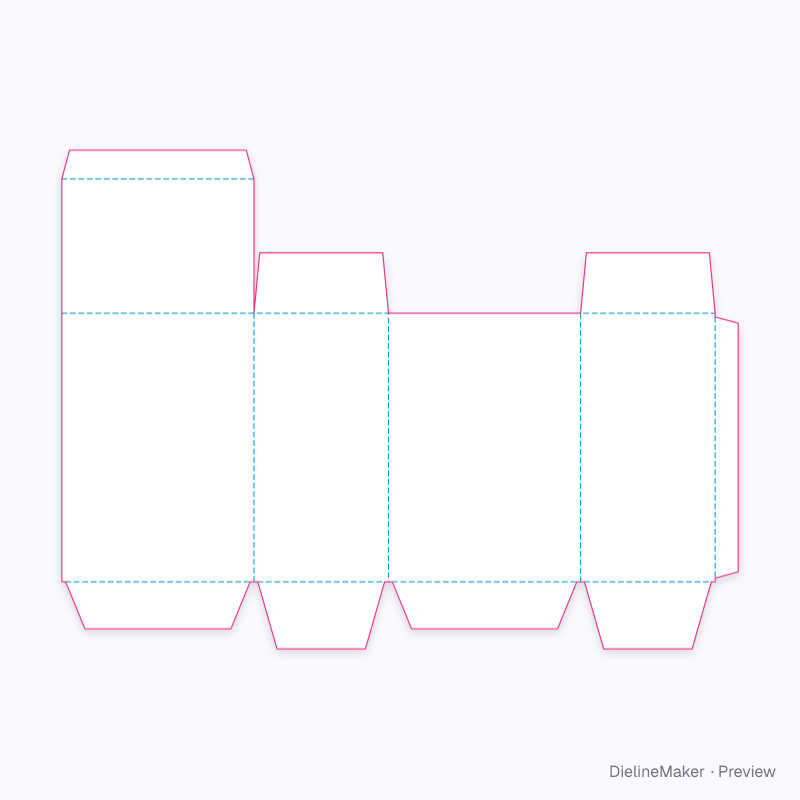
The straight-tuck wedge carton family
The same structure with sizes, boards and options set for a use.
Before you choose this template
Size, materials, downloads and production checks.
Will the wide praline chocolate wedge dieline fit my product?
A wide carton with a rectangular base, vertical back and sloping top. Both triangular end doors hinge from the back, tuck along the inside floor and close over dust flaps. One glued rear seam forms the body. Dimensions describe the clear body before closure plies; prove fit and scoring with the chosen board. The default dimensions in inside-size mode are Inside span 240 mm, Inside base depth 120 mm, Inside rear height 50 mm. Measure your product and any inserts or wrapping, then set the template size. Check a physical sample with your contents before ordering production.
Can I change the size and design?
Yes. The supported ranges are Inside span 80–400 mm, Inside base depth 40–240 mm, Inside rear height 25–150 mm. At the default settings, the editor also exposes End tuck depth, Dust flap depth. Add your own artwork and preview the result in 3D. The template geometry is rebuilt when its dimensions change.
Which materials can I choose?
The default is Black-core board 350 g (0.5 mm caliper). This structure allows SBS white board 350 g, Folding boxboard 400 g, Kraft board 350 g, Black-core board 350 g, SBS white board 18 pt. Select the stock before checking fit, and ask your converter to confirm the grade and caliper for the intended product.
Which files can I download?
The template page offers dimensioned PDF, Illustrator (.ai via script), layered SVG and DXF cutting and crease geometry. After adding artwork in the editor, you can export a print-ready PDF and review the bleed, safe areas and dieline layers with your printer.
Is this dieline free?
Browsing the previews is free, and you can customize the template after signing in with Google. Template and print-file downloads require a Pro or Business plan. The Free plan allows one eligible download every 8 hours; free mockups, renders and videos carry a watermark. See the pricing page for the current plans.
Can I send the download straight to production?
Use the file as a starting point for a printer or converter review. Confirm the finished dimensions, stock, crease and cutting setup, assembly, bleed and artwork, then approve a physical sample. The 3D preview does not test strength, transit performance or suitability for particular contents.
Similar structures
Other structures built in a similar way, matched on code family, category, closures and proportions.
Make this wide praline chocolate wedge yours
Open it in the editor to set your size, drop artwork on each face, check bleed and safe areas, and export print-ready PDF with the dieline on its own layer — or stage it in a 3D scene for a mockup.